Art as a Medium for Healing
In the United States, the pervasive impact of interpersonal and firearm-related violence has left deep scars on individuals, families, communities, and our nation as a whole. In its aftermath, we struggle to process the complex and wide range of emotions that arise. This emotional paralysis can hinder the healing process, leaving many searching for ways to articulate and process their grief.

Recently, my wife and I flew to Dallas, Texas, to visit our friends Dave and Pamela Emenheiser. While there, we visited the Sixth Floor Museum at Dealey Plaza, the site of the tragic assassination of President John F. Kennedy.
We also visited the Dallas Art Museum, to view an exhibition titled, “Marisol: A Retrospective.” The exhibit featured a collection of works by sculpture Marisol Escobar. One of Marisol’s sculptures, “The Funeral,” was her artistic response to President Kennedy’s assassination.
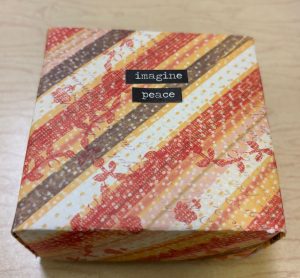
Upon our return to West Michigan, I learned from our friend Val Martin about the Soul Box Project, a nationwide initiative that empowers individuals to create their own meaningful sculptures in response to gun violence, helping foster both personal and communal healing.
A Nation in Mourning: “The Funeral”
“The Funeral” was created by Marisol Escobar in 1996 – more than 30 years after President Kennedy’s death – to capture the profound grief that enveloped America, and the world, following President Kennedy’s assassination. Her tableau, or living picture, features wooden figures arranged in a solemn procession, symbolizing the collective mourning of a nation. Looking down upon the toy-like procession, is a larger wooden sculpture of President Kennedy’s son, John Fitzgerald Kennedy Jr., making his famous salute to his father.
 Marsiol’s stated intent with the piece was to portray the “overwhelming sorrow” that enveloped the country following the event. Critics have commented on how the use of muted colors and austere expressions in the figures enhances the somber mood and gravity of the event. One of the powerful things about art, however, is how as individuals it reveals itself and speaks to each of us differently.
When I initially viewed the piece, I was first drawn to John Jr’s. facial expressions, body position and coat. I interpreted these combined elements as a symbolic representation of the passing of not only his father, but also, in many ways, of a passing of American innocence.
 One specific detail that caught my eye, that I haven’t read anyone else comment on, is the fact that the wooden figure of Jacqueline Kennedy stands on four legs. In my mind, this symbolized her unique burden of having to carry the weight of a wife, a mother, a first lady, and a cultural icon. No matter how we might individually interpret it, Marisol’s work serves as a poignant reminder of the enduring impact of violence on our society’s collective consciousness.
Soul Boxes: A Grassroots Response to Gun Violence
In contrast to Marisol’s singular artistic expression, the Soul Box project offers a participatory approach to addressing the epidemic of gun violence. This initiative invites individuals to create and personalize small, folded paper boxes – each symbolizing the life and soul of someone lost to gun violence. The act of creating a Soul Box is both personal and communal, allowing participants to channel their grief, anger, and hope into a tangible form.
“We do this with groups so that they can learn about the impact and have a visual about the actual numbers , because we get so weary when we hear about gun violence and we kind of lose perspective about how many people are impacted by it,” – Val Martin
 Soul Boxes empower individuals and communities to engage in dialogue and advocacy, transforming personal experiences into collective action. As the number of Soul Boxes grows, they create a powerful visual representation of the ongoing crisis, urging society to confront and address the pervasive issue of gun violence.
Local Soul Box facilitator Val Martin and her team have a goal of creating 1,406 boxes – the roughly average number of lives lost to gun violence in the State of Michigan every year. If you would like to learn more about this effort you can contact via e-mail at 326valmartin@gmail.com.
The Transformative Power of Art
Both Marisol’s “The Funeral” and the Soul Box project exemplify how art can be a powerful tool for healing, advocacy, and transformation in the face of tragedy. Engaging with these works invites us to confront the emotional and social dimensions of violence, fostering a deeper understanding and commitment to building a more peaceful society.
As we reflect on these artistic responses, I believe we are called to remember those lost to violence and to envision a future where such tragedies are no longer part of our narrative.
Credits: Grand Haven Tribune Reporter Addelyn Wachter for Val Martin quotes and Val Martin for Soul Box photos.